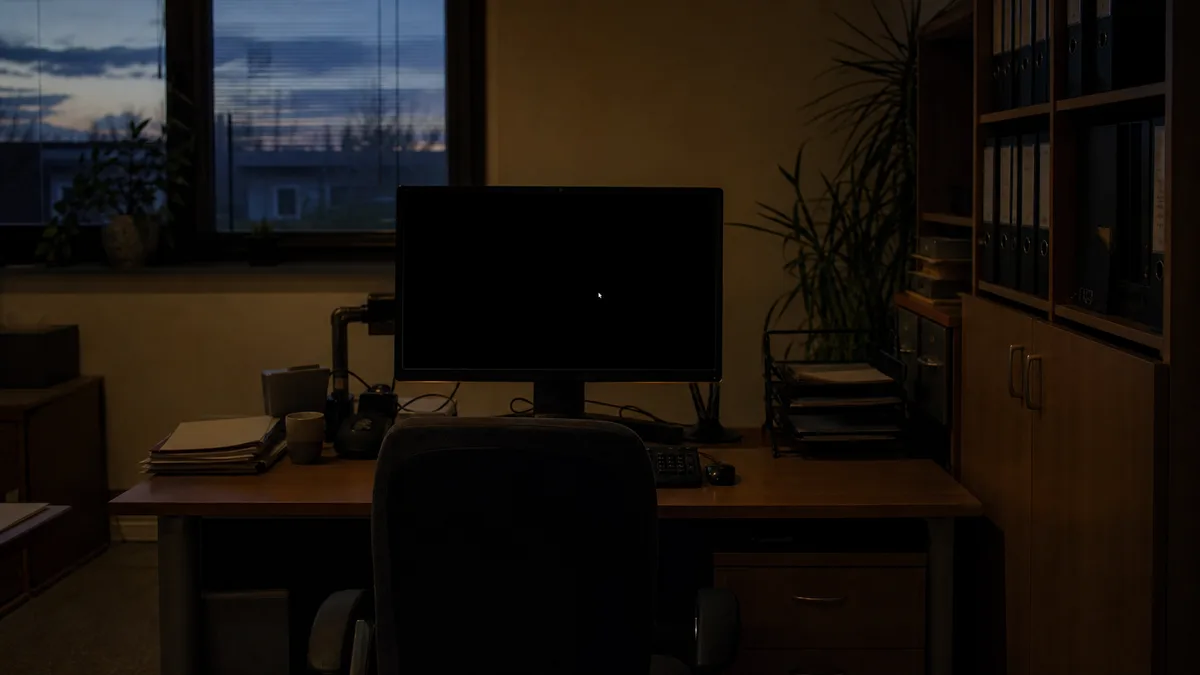
The login screen appears normally. Your password or PIN is accepted. And then nothing — a black screen, a cursor in the middle that obediently follows the mouse. No taskbar, no icons, no Start menu. The computer is clearly running, but you can’t do anything at all with it.
This state looks worse than it usually is. In the vast majority of cases, neither the disk nor the graphics are broken — just one component of Windows that draws the desktop failed to start. The bad news is that most people’s first reaction (holding the power button to try again, or going straight to “reinstall”) can turn a minor issue into an extra day’s work.
Immediate answer: Press
Ctrl + Alt + Delete. If a blue screen appears with the options Lock / Sign out / Task Manager, the system is running, and the problem lies between login and the desktop loading. Open Task Manager, select Run new task, and typeexplorer.exe. If the desktop appears, save any work in progress and restart — you only have temporary access, not a fix. If the black screen returns after every login, do not touch reset or reinstallation without a backup, and have the driver, profile, and system files checked.
When it’s this problem and when it’s something else
We’re talking about a black screen after login, with a visible cursor. This is a software issue in Windows 10 and 11.
These cases are something else entirely:
- black screen immediately after powering on, before the login screen,
- non-functional display backlight (the image is there, it just can’t be seen),
- colored stripes, blocks, and artifacts,
- computer with no image, even in the BIOS,
- a laptop that won’t turn on at all.
These involve the display, RAM, graphics chip, motherboard, or power supply. We cover stripes and artifacts separately in the article graphics issues: artifacts, stripes, or black screen, and a lifeless laptop in the article laptop won’t turn on.
Quick classification based on what you see:
| What you see | Where the problem likely is | What to try first |
|---|---|---|
Black screen, cursor, Ctrl + Alt + Delete works | Windows Explorer or profile | Manually launch explorer.exe |
| Black screen started after an update | Graphics driver or update | Restart driver, safe mode |
| Only happens with a docking station | Video output, dock, its driver | Disconnect dock and external monitors |
| Another account logs in normally | Corrupted user profile | Don’t delete the original profile, back up first |
| No login screen or BIOS is visible | Hardware, display, power supply | Hardware diagnostics |
Restart, but do it right
Before you start trying anything, give it a few minutes. Windows may be finishing an update or waiting to connect to corporate services, and the desktop will load on its own.
When nothing happens, use Ctrl + Alt + Delete, the power icon in the bottom right, and Restart. Not Shut down. By default, Windows has fast startup enabled — during shutdown, the kernel and driver states are saved to disk and simply reloaded on the next start. Shutting down and turning back on might therefore not clear the faulty state, whereas a restart discards it and loads the system anew. This is also why “I turned it off and on again and it didn’t help” means nothing for this particular fault.
Leave holding the power button as a last resort when even Ctrl + Alt + Delete doesn’t respond. Forced shutdown can corrupt files that are being written to, and in a company setting, it might interrupt OneDrive synchronization or writing to an accounting program.
Manually launching the desktop via Explorer
The desktop, taskbar, Start menu, and file windows are all drawn by a single process: explorer.exe. If it fails to start after login or crashes, you’re left with exactly what you see — a background and a cursor.
- Press
Ctrl + Shift + Esc. If Task Manager doesn’t open, access it viaCtrl + Alt + Delete. - Choose Run new task (in the older interface, File → Run new task).
- Type
explorer.exeand confirm. - If Windows Explorer is already running in the process list, right-click on it and select Restart.
If the desktop appears, half the battle is won. You’ve gained access to the computer, not a fix. Save any work in progress, back up what’s necessary, and restart. If the black screen returns upon next login, something is repeatedly blocking Explorer — a program, a driver, or a corrupted profile.
When Windows is sending the image elsewhere
A typical office scenario: a laptop in a USB-C dock, plus one or two monitors. After a Windows or driver update, the output the system considers primary changes — and the desktop gets rendered on a monitor that is currently turned off or disconnected. Meanwhile, the internal display shows black with a cursor.
Disconnect the dock, adapters, and external monitors, and restart. Then try Windows + P and select PC screen only. Reconnect devices one at a time, not all at once — otherwise, you won’t identify the culprit. With docks using DisplayLink technology, their driver is a common offender that falls out of sync with a new Windows version.
You can try to wake the graphics subsystem using Windows + Ctrl + Shift + B. The screen will flash briefly, and the computer may beep. The driver simply reinitializes — nothing is deleted and the computer doesn’t restart, so you can try this without concern.
When it started after an update
The most common combination where this breaks involves laptops with hybrid graphics — integrated Intel or AMD graphics plus a dedicated NVIDIA or AMD chip, between which the system switches. A new driver might not align with the specific model, the docking station, or just that switching ability.
If you get to the desktop via explorer.exe, open Device Manager, expand Display adapters, and in Properties on the Driver tab, look for Roll Back Driver. The button is only active if Windows has a saved previous version — which it usually does after a fresh update.
Two things not to do. Don’t download “driver updater” programs promising to fix drivers in one click — they’re more likely to bring another problem than an extra driver. And on a laptop, don’t blindly uninstall the graphics driver: laptop manufacturers often supply a customized version for graphics switching and backlight control, so a generic package from Intel, AMD, or NVIDIA may not fully replace it. Before changing anything, note down the current version.
Safe mode separates the wheat from the chaff
If the black screen returns with every login, it’s time for safe mode. Use Ctrl + Alt + Delete to open the power menu, hold Shift, and click Restart. Then Troubleshoot → Advanced options → Startup Settings → Restart → Safe Mode.
Beware of one thing: on an encrypted computer, the recovery environment will ask for the BitLocker recovery key. You won’t proceed without it, and trial-and-error doesn’t work here. The key is usually in your Microsoft account, in Microsoft 365 for a corporate device, or in the IT admin’s records — where to find it is described in the article what is BitLocker and in more detail when the disk won’t unlock. Obtain the key before you start restarting.
If the desktop loads in safe mode, the culprit is among drivers, auto-starting applications, or third-party services. Focus on what changed just before the fault appeared: security software, graphics and docking tools, remote management, programs modifying the Start menu appearance. Don’t bulk-disable Microsoft services or corporate security tools — and above all, write down what you’ve changed, otherwise you’ll get lost in your own interventions.
Repairing system files without reinstallation
Corrupted system files can also block Explorer from starting. In Task Manager, choose Run new task, type cmd, and check the box to run with administrative privileges. Then run sequentially:
DISM.exe /Online /Cleanup-Image /RestoreHealth
sfc /scannow
The order is no accident. DISM repairs the component store — the source from which Windows takes replacement system files. Only then does it make sense to run SFC, which compares protected files and replaces corrupted ones from that store. If run in the reverse order and the store is corrupted, SFC has nothing to repair with. Do not turn off the computer during the scan.
However, this is not a substitute for a backup and especially won’t fix a failing disk. If the computer freezes, the disk makes unusual noises, or the system reports read errors, each additional round of repair is more likely to worsen the situation — more in the article about bad sectors.
A corrupted profile is identified by using another account
Does another account log in normally while yours sees black? Then it’s most likely a corrupted user profile. Causes include an interrupted update, an error in the profile registry record, or an unsuccessful settings synchronization. A telltale sign is also logging into an empty desktop with default settings — Windows gave you a temporary profile because it couldn’t load your own.
Don’t delete the original account. The profile folder contains Documents, Desktop, local mail, saved passwords, certificates, templates, and application data in AppData — things that may not be in any cloud synchronization. And with OneDrive, don’t assume files are truly uploaded; they are often marked as available only locally or, conversely, only in the cloud.
The solution is to create a clean profile, transfer user data into it, and reconnect the work account. For a corporate computer, this includes verifying access to Microsoft 365, network drives, VPN, printers, and the accounting or warehouse program. Seeing the desktop doesn’t yet mean the working environment is complete.
When to stop trying
Hand the computer over for diagnostics when:
- the black screen returns after every restart,
- even safe mode ends with a blank screen,
- you need to preserve business programs and their settings,
- you don’t have the BitLocker recovery key,
- important data exists in only one copy,
- the black screen is accompanied by freezes, spontaneous restarts, or disk errors,
- you don’t know which change caused it.
One rule is strict: without a backup, do not touch Reset this PC or a clean installation. Reset can delete the contents of the system disk, including local databases and program configurations — and data that was fine up to that moment suddenly becomes a case for data recovery. You first need to find out where the data is and if it’s readable. Whether it even makes sense to reinstall the system, or if it’s time for a new machine, is discussed in the article reinstallation or a new computer.
What it might roughly cost
To be fair: it can’t be said without diagnostics. There’s a vast difference in time and price between “restarting Explorer” and “transferring a profile and rebuilding the working environment of a corporate laptop.” Therefore, we’ll provide an indicative price based on the current price list only after diagnostics, and we won’t proceed with anything without your consent.
Before approving the repair, have the following confirmed:
- what the diagnostics found,
- whether the price includes backing up user data,
- whether installed programs will remain,
- what you’ll need to re-authenticate or set up after the repair,
- what to do to prevent it from happening again.
A good result isn’t a computer that shows the desktop once. A technician should verify repeated login and restart, the state of the driver and updates, the profile, and common work functions. For a corporate computer, also access to documents, the network, and peripherals.
How to reduce the risk of it returning
Leave enough free space on the system disk — when it runs out, Windows behaves unpredictably during updates and logins; how to free it up is described in the guide to freeing up disk space in Windows 11. Don’t install unknown driver updaters. Keep the BitLocker recovery key stored somewhere other than the computer it belongs to. And before a major update, have a fresh backup of your work data.
If the problem recurs, note down the time, the last installed update, and what was connected. This one note will advance diagnostics further than an hour of power-cycling and trying random guides from the internet.